


Sarah Petrich, PT, DPT, PRC, NCPT Many abdominal exercises practiced in rehab are designed to isolate the abdominals from other muscles and don’t train the abdominals in multiple planes of motion. There is a time and place for that kind of work, but that is not how we function in everyday movement. In reality, our deep abdominals don’t function alone during functional activities.
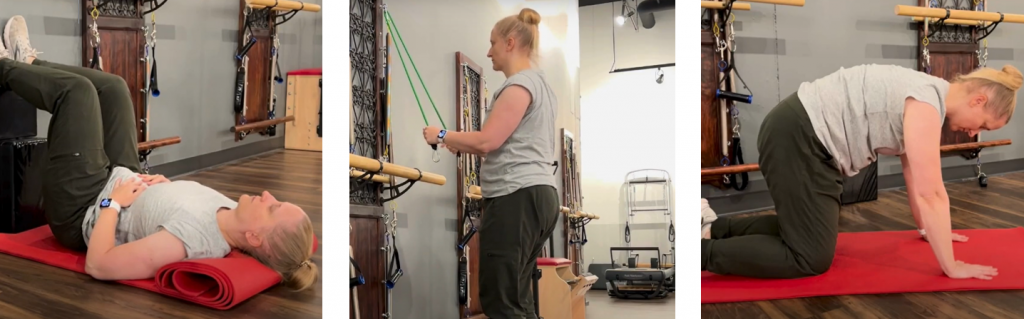
Many abdominal exercises practiced in rehab are designed to isolate the abdominals from other muscles and don’t train the abdominals in multiple planes of motion. There is a time and place for that kind of work, but that is not how we function in everyday movement. In reality, our deep abdominals don’t function alone during functional activities. Abdominals integrate with other muscles as specialists in connecting and coordinating the upper body and lower body in multiple planes of movement. Some muscles are more neurologically primed to easily train these abdominal connections and functional patterns of movement. They can potentially give us a quicker, easier avenue to help our patients discover and utilize their core faster and easier. I refer to these muscles as abdominal muscle buddies.
Below are my 3 favorite abdominal muscle buddies, inspired by concepts from the Postural Restoration Institute®, with exercise examples on how one can use them to engage deep abdominals effectively. ONE IMPORTANT NOTE… all of these abdominal muscle buddies work best when paired with a slow purposeful breath pattern of: full exhale, pause for at least 3 seconds, and inhale through the nose.
Hamstrings
Hamstrings can extend a hip, they can flex a knee, and they can stabilize an innominate bone in a neutral pelvis position. When hamstrings stabilize the pelvis (pulling the sit bone inferior – when in a 90/90 position it creates a decompressive posterior pelvic tilt), the internal obliques can help internally rotate the ribs above creating the correct posture of the ribcage for good diaphragm mechanics WITH coordinated abdominals.
Triceps
Triceps, like hamstrings, also have multiple functions. One of those possible functions is to use tricep arm extension to help internally rotate the contralateral ribs helping engage the contralateral internal obliques. These obliques provide the correct ribcage position for properly coordinated diaphragm and abdominal mechanics.
Serratus Anterior
The serratus anterior is often thought of as only a scapula protractor…but when the scapula protracts the ribcage retracts simultaneously (it’s the same thing but looking at it from a different vantage point). When a ribcage retracts the ribs can internally rotate helping engage the valuable IO’s & TA’s, particularly when paired with good-quality breath work. This muscle, when trained well, coordinates ribcage posture, diaphragm mechanics, and abdominals with the shoulder for functional re-training.
Want to learn more? Join my Summit Live Webinar in August, Improving Core Strength and Stability. This interactive course will enhance your reasoning for prescribing specific exercises, be more effective at instructing the exercises, and be able to progress patients to greater efficient functional movement. If you can’t attend or miss it, no worries – you can always watch the On-Demand version here.
Visit summit-education.com for more information.