


Kristen DaCosta, PT, MA, DPT Has anything changed in the human body since our inception? People are living longer, yes, but our physiological form has, for the most part, remained intact and unchanged. So why are doctors saying it’s okay if babies skip crawling? Many people may not know but doctors removed crawling off the developmental milestone checklist. When and why did this happen?
 Has anything changed in the human body since our inception? People are living longer, yes, but our physiological form has, for the most part, remained intact and unchanged. So why are doctors saying it’s okay if babies skip crawling? Many people may not know but doctors removed crawling off the developmental milestone checklist. When and why did this happen?
In 2021, the American Academy of Pediatrics (AAP) and the Centers for Disease Control and Prevention (CDC) no longer considers crawling an official milestone. The main reason is they were unable to accurately determine when 75% of babies should begin crawling. As a pediatric physical therapist for over 20 years, I am outraged over this and could not disagree more.
Through focused and committed research, a range of ages could have been determined. Instead, the lack of commitment and focus resulted in the removal of this important milestone from their checklist.
Another main reason the AAP and CDC removed the crawling milestone is societal change (Back to Sleep program, “container syndrome”, technology). Should we accept this? The answer is clear – NO!! Physical therapists, occupational therapists, developmental specialists, and pediatricians should be outraged, and here is why.
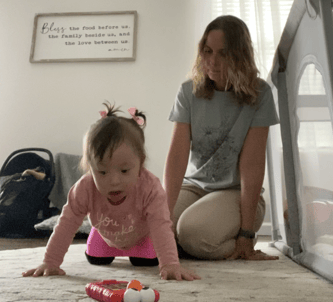
Crawling is not only important but also essential! Babies learn through exploration and what better way to explore than crawling on all fours? Crawling is considered the first type of independent locomotion and is vital for the development of the vestibular, balance, and sensory systems. The benefits are countless and include, but are in no way limited to:
- Establishing body awareness
- Developing motor planning and problem-solving skills
- Increasing core strength
- Developing the palmar arch
- Improving shoulder stability
- Aiding the left and right sides of the body to work together to improve coordination
- Enhancing depth perception
So, where do we go from here? We continue to educate everyone and anyone – parents, caregivers, families, neighbors, colleagues. We get the word out that crawling continues to play a critical role in a child’s development. We stress the significance of tummy time (when awake and alert), floor time, exploration, language development, cause-and-effect toys, sensory development, and no passive screen time.
Join me for my Live Streams on April 25th and April 26th where we take a deeper dive into all things Pediatric Rehabilitation. Explore the courses below and I hope you will join us!
Visit summit-education.com for more information.
References:
Centers for Disease Control and Prevention, Milestone Moments Booklet 2021 (cdc.gov). 2021.
Kretch KS, Dusing SC, Harbourne RT, Hsu LY, Sargent BA, Willett SL. Early Mobility and Crawling: Beliefs and Practices of Pediatric Physical Therapists in the United States. Pediatr Phys Ther. 2024;36(1):9-17. doi:10.1097/PEP.0000000000001063
Hewitt, Lyndel, et al. “Tummy time and infant health outcomes: a systematic review.” Pediatrics6 (2020).
Grad E. Tummy time in infants. El tiempo en posición boca abajo de los lactantes. Arch Argent Pediatr. 2023;121(6):e202310119. doi:10.5546/aap.2023-10119.eng
Mendres-Smith AE, Borrero JC, Castillo MI, Davis BJ, Becraft JL, Hussey-Gardner B. Tummy time without the tears: The impact of parent positioning and play. J Appl Behav Anal. 2020;53(4):2090-2107. doi:10.1002/jaba.715
Madigan S, Browne D, Racine N, Mori C, Tough S. Association Between Screen Time and Children’s Performance on a Developmental Screening Test . JAMA Pediatr. 2019;173(3):244-250. doi:10.1001/jamapediatrics.2018.5056
Visser, Magrieta Maria and Denise Franzsen. “The association of an omitted crawling milestone with pencil grasp and control in five- and six-year-old children.” South African Journal of Occupational Therapy40 (2010): 19-23.
Hewitt L, Kerr E, Stanley RM, Okely AD. Tummy Time and Infant Health Outcomes: A Systematic Review. Pediatrics. 2020;145(6):e20192168. doi:10.1542/peds.2019-2168
Xiong QL, Wu XY, Liu Y, Zhang CX, Hou WS. Measurement and Analysis of Human Infant Crawling for Rehabilitation: A Narrative Review. Front Neurol. 2021;12:731374. Published 2021 Oct 11. doi:10.3389/fneur.2021.731374
Xiong QL, Hou WS, Xiao N, et al. Motor Skill Development Alters Kinematics and Co-Activation Between Flexors and Extensors of Limbs in Human Infant Crawling. IEEE Trans Neural Syst Rehabil Eng. 2018;26(4):780-787. doi:10.1109/TNSRE.2017.2785821