


This maneuver provides clinicians with a quick and effective method for confirming BPPV, allowing for swift diagnosis in various clinical settings. Its ease of use makes it a go-to technique for healthcare providers, particularly those working with patients experiencing vertigo. In addition to the traditional approach, there are several variations of the maneuver that have been developed to accommodate specific patient needs, such as those with mobility limitations or other underlying conditions.
The Dix-Hallpike Maneuver is widely regarded as the gold standard for diagnosing benign paroxysmal positional vertigo (BPPV), due to its high sensitivity and simplicity. This maneuver provides clinicians with a quick and effective method for confirming BPPV, allowing for swift diagnosis in various clinical settings. Its ease of use makes it a go-to technique for healthcare providers, particularly those working with patients experiencing vertigo. In addition to the traditional approach, there are several variations of the maneuver that have been developed to accommodate specific patient needs, such as those with mobility limitations or other underlying conditions. These variations are presented here for further exploration and practical application.
The Dix Hallpike Maneuver:
Patient long sitting on a mat or bed, therapist behind:
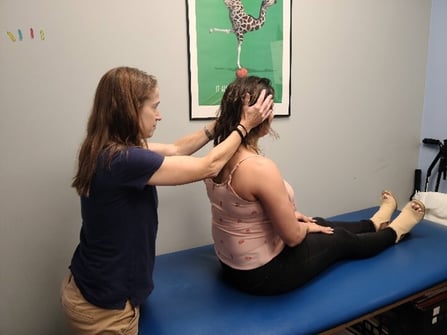
Patient’s head is turned 45 degrees to the side being tested:
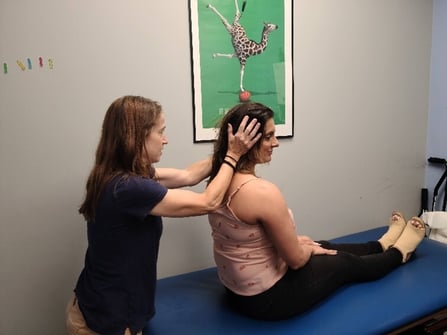
Lie patient down within 1 to 2 seconds (Timing is not well described in literature):
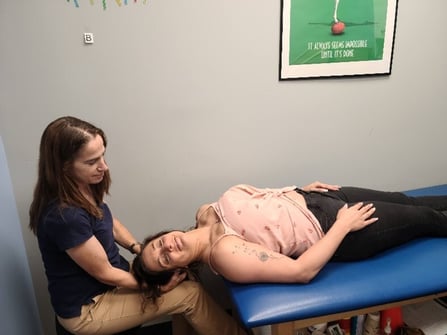
- Patients head should be 20 degrees to 30 degrees below horizon and off the edge of the bed /mat
- Nystagmus and dizziness usually elicited within 30 seconds
- The affected ear will be down
- Repeat maneuver on the opposite side
- If nystagmus is up beating and torsional toward the affected ear, a diagnosis of Posterior Semicircular Canal BPPV can be made
- If there is no nystagmus or nystagmus is horizontal, a Supine roll test should be performed.
Variations of the Dix Hallpike:
- Loaded Dix Hallpike
- Done when improved sensitivity is needed or desired
- Same as the Dix-Hallpike test described above except
- Prior to lying the patient down, patients head is rotated 45 degrees and flexed forward 30 degrees
- This positioning results in more intense and longer lasting nystagmus and helps prevent false negative results
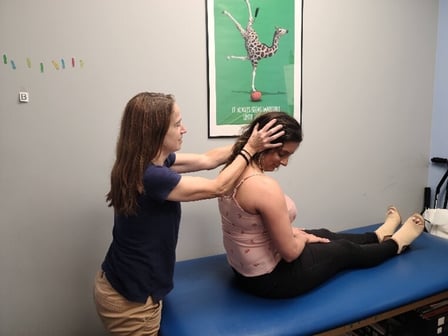
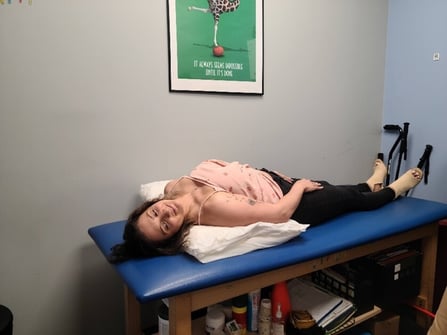
- Dix Hallpike with pillow under shoulders
- Done when head hanging off the surface is not an option
- Same as the Dix-Hallpike test described above except
- Pillow is placed behind the patient’s buttocks in long sitting
- When the patient lies down, the patient’s shoulders are on the pillow allowing the patient’s head to rest on the surface. The patient’s head is not brought over the side of the bed/mat.
Interested in learning more about Vestibular Rehab & Balance Training? Click here to watch my Summit On-Demand CE Course anytime! Or, Find an In-Person course near you for a hands-on experience!
CLICK HERE to view Karen Hogan-Curran‘s Instructor Page.
References:
Andera, L., Azeredo, W. J., Greene, J. S., Sun, H., & Walter, J. (2020). Optimizing Testing for BPPV–The Loaded Dix-Hallpike. The Journal of the International Advanced Otology, 16(2), 171+. http://0b30hm2od.mp02.y.http.dx.doi.org.prx-usa.lirn.net/10.5152/iao.2020.7444
Bhattacharyya, N., Gubbels, S. P., Schwartz, S. R., Edlow, J. A., El-Kashlan, H., Fife, T., Holmberg, J. M., Mahoney, K., Hollingsworth, D. B., Roberts, R., Seidman, M. D., Prasaad Steiner, R. W., Do, B. T., J. Voelker, C. C., Waguespack, R. W., & Corrigan, M. D. (2017). Clinical Practice Guideline: Benign Paroxysmal Positional Vertigo (Update). Otolaryngology–Head and Neck Surgery. https://doi.org/10.1177/0194599816689667
Jeon, E.-J., Lee, D.-H., Park, J. M., Oh, J.-H., & Seo, J.-H. (2019). The efficacy of a modified Dix-Hallpike test with a pillow under shoulders. Journal of Vestibular Research: Equilibrium & Orientation, 29(4), 197–203. https://doi.org/10.3233/VES-190666
Lieberz, D., Borstad, A., & Nelson, J. (2024). A cross-sectional methodological study: evaluation of the examiner performance on the Dix-Hallpike test. Disability & Rehabilitation, 46(13), 2933–2938. https://doi.org/10.1080/09638288.2023.2237893