


Catherine Valentino OTD, OTR/L MAAL, MHSc, BS, FMT Being a healthcare practitioner can be challenging, being a patient is also difficult at times. However, being a caregiver can often be the most arduous role. As a caregiver, you face complex hurdles as you strive to promote quality of life for your loved one while also working to find the best quality care. As a care provider to a loved one with dementia , your role faces uncertainties which may be changing throughout the day due to complications such as sundowning.
 Being a healthcare practitioner can be challenging, being a patient is also difficult at times. However, being a caregiver can often be the most arduous role. As a caregiver, you face complex hurdles as you strive to promote quality of life for your loved one while also working to find the best quality care. As a care provider to a loved one with dementia, your role faces uncertainties which may be changing throughout the day due to complications such as sundowning. The possibility of adverse behaviors as well as the changes accompanying the specific dementia diagnosis can also weigh heavily on your day-to-day activities. Luckily, there has been a new focus on caregiver health, caregiver quality of life, and resources to better equip those caring for a loved one with dementia to meet patient demands and have success!
Current research emphasizes non-pharmacological options caregivers can integrate into their daily routine to improve patient and caregiver quality of life (QoL). Caregiver QoL is vital for the effective and positive execution of caregiver roles. Sun et al (2023) suggests support group participation to facilitate caregiver mental health as well as education on what to expect at each stage of dementia greatly changing outcomes for both parties.  The Dementia Stages Ability Model app is a valuable resource to provide insight into each stage of dementia and what your loved one needs for support. There are many caregiver resources available from international organizations and checking out the caregiver resource pages from the Alzheimer Organization can be helpful to link caregivers to local resources. Resources for safe activities are also listed on the Alzheimer’s Organization webpage. Dementia Australia has some fabulous ways to break activities down or initiate activities with patients at different levels of dementia. You can access Dementia Australia’s activity information here. Let’s explore some helpful tips and tricks that will make incorporating meaningful activity easier for patients suffering from dementia.
When it comes to maximizing function for dementia patients the sooner routines can be established following a dementia diagnosis the better chances of carry-over there will be for each activity. In early, or mild dementia, there is a chance for learning new routines with high repetition. This is the perfect opportunity to establish safe routines, incorporate mindfulness activities, and develop activity management planning (Scerbe et al., 2023). Below are some techniques which facilitate function, decrease adverse behavior incidents, and assist with promoting function throughout the disease process. The key for success in activity participation is to keep it simple and maximize long-term and procedural memory (think about activities that have been lifelong hobbies).
 Music is a great option that is accessible and easy to incorporate into daily activities. Choose music to promote restfulness, activity, or reminiscing. Using music with a steady beat during mobility activities facilitates natural timing, activation of the motor cortex, and movement patterns.
- Placing pictures on drawers and cabinets to identify what is inside can reduce behaviors from lost items.
- Allow for exploration. Have activities accessible that are all safe options for your loved one. For example, if they love to fish perhaps, they can work with safe tackle like stringing bobbers or putting weights on fishing lines. *As a patient progresses through dementia stages it is important to be mindful of behaviors such as mouthing items to remove choking hazards even with familiar objects.
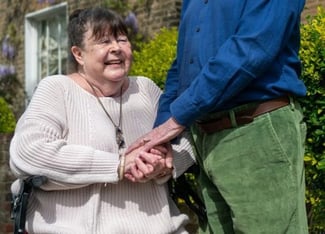
- People will recognize gestures longer than words and they can be easier to process. If you would like your loved one to get up and go with you somewhere, offer your hand palm up and let them use that familiar gesture to initiate a “leading” activity.
- Check out “A Walk Through Dementia” from Alzheimer’s Research UK which has an interactive Dementia Simulator. This tool is great for putting yourself in the shoes of someone with dementia.
Learn more by joining my upcoming Summit Live Webinar, Effective Treatment for Each Stage of Dementia, on July 22nd. This course aims to demystify the workings of each stage of dementia and develop clinical confidence in being able to not only make a positive impact on these clients but also be able to support the caregivers.
Explore some online continuing education courses from Catherine below:
Achieving Functional Progression in Dementia Care
Multidisciplinary Approach Discharge Recommendations in Acute Care
Visit summit-education.com for more information.
References:
Alzheimer’s Association. (2020). 50 Activities. Alzheimer’s Disease and Dementia. https://www.alz.org/help-support/resources/kids-teens/50-activities
Alzheimer’s Association. (2020). Helpline. Alzheimer’s Disease and Dementia. https://www.alz.org/help-support/resources/helpline
Alzheimer’s Research UK. (n.d.). A Walk Through Dementia. Alzheimer’s Research UK. https://www.alzheimersresearchuk.org/campaigns/awtd/
Dementia Australia. (2024). Activities for people with dementia. Www.dementia.org.au. https://www.dementia.org.au/living-dementia/staying-connected/activities-people-dementia
Scerbe, A., Megan E. O’Connell, Astell, A., Morgan, D., Kosteniuk, J., Panyavin, I., DesRoches, A., & Webster, C. (2023). Digital tools for delivery of dementia education for caregivers of persons with dementia: A systematic review and meta-analysis of impact on caregiver distress and depressive symptoms. PLoS One, 18(5)https://doi.org/10.1371/journal.pone.0283600
Sun, Y., Ji, M., Leng, M., Li, X., Zhang, X., & Wang, Z. (2022). Comparative efficacy of 11 non-pharmacological interventions on depression, anxiety, quality of life, and caregiver burden for informal caregivers of people with dementia: A systematic review and network meta-analysis. International journal of nursing studies, 129, 104204. https://doi.org/10.1016/j.ijnurstu.2022.104204